Christian Resurrection Day True Story: Graphics & Crafts Review
Evaluating Visual Tone for Faith-Based Client Projects
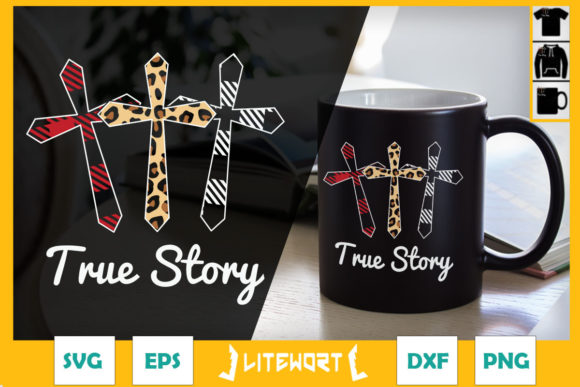
When reviewing a new graphic design asset for a client project, my first assessment always focuses on emotional resonance and technical versatility. For a recent commission involving a boutique faith-based lifestyle brand, I needed an illustration that balanced reverence with modern accessibility. The Christian Resurrection Day True Story immediately stood out during this selection process. Unlike generic religious clipart that often feels dated or overly ornate, this asset presents a narrative quality that feels grounded and authentic. It evokes a sense of hope and historical weight without becoming visually heavy, making it suitable for contemporary small business branding that wants to honor tradition while appealing to a modern demographic.
The visual mood is distinctly warm and storytelling-driven. For designers working in the Crafts category, this distinction is vital. We are not just decorating a surface; we are communicating a message. This asset succeeds because it treats the subject matter with artistic integrity rather than treating it as mere decoration. When I integrated it into our initial mood board, it anchored the entire color palette, suggesting soft earth tones and muted golds that translated beautifully across both digital and physical touchpoints. It feels less like a stock graphic and more like a bespoke illustration commissioned specifically for narrative depth.
Technical Performance Across Print and Digital Mediums
A pretty image is useless if it fails in production. As a professional designer, I need to know how a file behaves under pressure. The Christian Resurrection Day True Story package is robust, providing the essential formats required for a multi-channel campaign. Receiving 1 SVG, 1 PNG, 1 DXF, and 1 EPS file in a single ZIP ensures that whether I am designing a website hero section or cutting vinyl for a church event banner, the source material is ready.
In testing the SVG design for a Cricut project, the vector paths were remarkably clean. There were no stray nodes or overlapping layers that often plague cheaper design bundles. This cleanliness is non-negotiable for sticker design or intricate paper crafts where cut lines must be precise. The DXF inclusion is a significant value-add for users of Silhouette Studio or other cutting software that requires specific line-art formatting. For my client’s apparel line, the EPS file scaled effortlessly to large-format dimensions for t-shirt design without losing edge definition, while the high-resolution PNG served perfectly for social media graphics and web design overlays where transparency is key.
For those utilizing Canva template workflows, the PNG integrates seamlessly. However, I recommend using the SVG if you have Canva Pro or Illustrator access, as it allows you to recolor elements to match your specific brand identity. This flexibility transforms a static digital product into a dynamic component of a larger visual system.
Ideal Applications for Narrative-Driven Design
This asset shines brightest when given room to breathe. In my client project, we utilized Christian Resurrection Day True Story as a primary focal point rather than background texture. It is exceptionally effective for:
- Packaging Design: As a central label element for artisanal goods, candles, or journals where the story adds perceived value.
- Editorial Design: Serving as a chapter opener or pull-quote accent in printed devotionals or blog visuals.
- Printable Wall Art: The composition is balanced enough to stand alone as a framed piece, requiring only minimal typography to complete the layout.
- Marketing Visuals: Creating cohesive Instagram carousels or Pinterest pins that drive engagement through meaningful imagery.
- Sublimation Design: The detail level holds up well on mugs and tumblers, provided the output resolution is managed correctly.
For Etsy product sellers and print-on-demand businesses, this asset offers a unique selling proposition. It moves beyond standard holiday clichés, allowing creators to offer products that feel thoughtful and curated. In commercial design contexts, such as church bulletins or conference programs, it provides a professional polish that elevates the perceived quality of the organization.
Navigating Limitations and Visual Hierarchy
No single asset is universal. While Christian Resurrection Day True Story is versatile, it demands respect for visual hierarchy. Because of its illustrative nature and inherent detail, it struggles in small-scale applications. I would advise against using this as a tiny favicon, a secondary logo mark, or within dense text-heavy layouts. At reduced sizes, the narrative details can muddy, reducing legibility and impact.
Furthermore, designers should exercise caution when pairing this with highly complex backgrounds. The asset carries its own visual weight; placing it over a busy photograph or textured pattern can create visual noise. It performs best on solid colors, subtle gradients, or negative space. For minimalist branding projects that rely on stark whitespace and sans-serif typography, ensure the illustration’s style aligns with your brand voice. If your brand is ultra-modern and geometric, this organic, story-rich aesthetic might create dissonance unless intentionally used as a contrasting element.
Readability is another consideration. If incorporating text directly into or around the clipart, ensure sufficient contrast. The emotional appeal of the piece relies on clarity; if the viewer has to squint to understand the scene, the connection is lost. Always prioritize the message over the decoration.
Professional Pre-Flight Checklist for Commercial Use
Before finalizing any creative design for a client, I run a rigorous quality assurance protocol. When working with Christian Resurrection Day True Story, I recommend the following steps to ensure professional results:
- Verify Licensing: Always confirm the commercial license terms included with the download. Ensure your intended use (e.g., POD vs. handmade vs. digital end-products) aligns with the creator's permissions.
- Contrast Testing: Test the PNG on both white and dark backgrounds. Some illustrations lose internal definition on dark modes; you may need to add a subtle outer glow or adjust brightness for modern design dark themes.
- Typography Pairing: Experiment with different font styles. A classic serif enhances the traditional "True Story" aspect, while a clean sans-serif modernizes it. Avoid overly decorative script fonts that compete with the illustration’s own intricacy.
- Mockup Validation: Never approve a design based on screen view alone. Place the asset on realistic product mockups to judge scale and proportion. What looks good at 100% zoom may look overwhelming on a coffee mug or too small on a tote bag.
- File Integrity Check: Open the SVG in multiple programs (Illustrator, Inkscape, Cricut Design Space) to verify layer structure. Ungroup elements to test editability. A truly useful design asset should be adaptable, not locked.
By treating Christian Resurrection Day True Story as a professional tool rather than just a seasonal decoration, designers and makers can unlock its full potential. It bridges the gap between faith-based messaging and high-quality Graphics, offering a sophisticated solution for brands that value authenticity. Whether you are building a handmade business portfolio or executing a large-scale marketing campaign, this asset demonstrates that meaningful content and excellent design are not mutually exclusive. It is a worthy addition to the library of any creative professional serving the faith market, provided it is applied with intentionality and technical care.